
Context and Timeline of the Coup d'État Hoax
Between December 9 and 10, 2025, a viral video circulated widely on Facebook, claiming to show the announcement of a coup d'état in France. This video, entirely generated by artificial intelligence, reached over 13 million views in just a few days before being gradually removed by its creator. The video featured a fake journalist in front of the Élysée, holding a microphone branded with a fictional news channel called "Live 24" (mimicking the visual codes of France 24 or other real news channels).
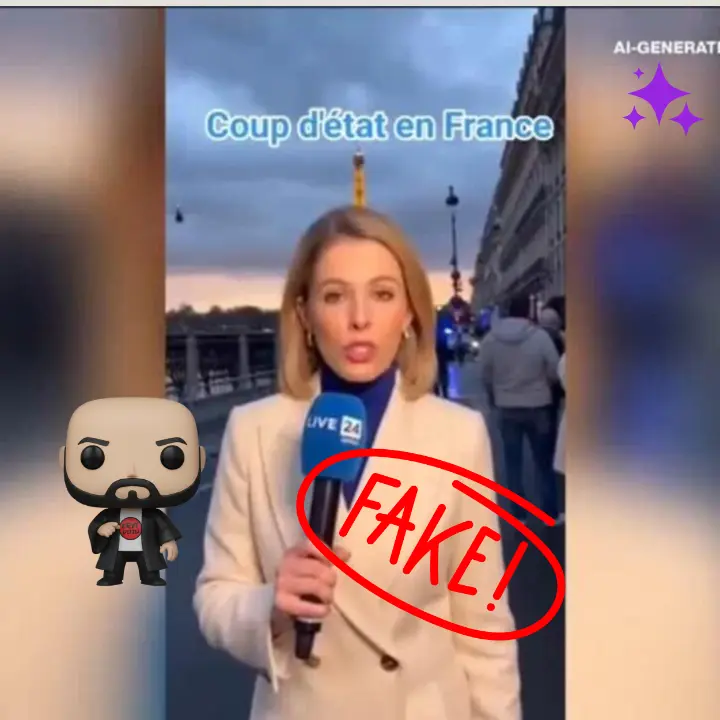
The Content of the Hoax
In this ultra-realistic sequence lasting about fifteen seconds, the journalist announces: "Currently, unofficial reports indeed suggest a coup d'état in France, led by a colonel whose identity has not been revealed, and the possible downfall of President Emmanuel Macron." The staging also included images of helicopters flying over Paris and soldiers stationed in the streets, all accompanied by an angry crowd. The appearance was realistic enough to deceive millions of people, including international political leaders who contacted Emmanuel Macron with concern.
Presidential Reaction and Official Denials
On December 16, 2025, during a visit to Marseille to meet with readers of the newspaper La Provence, Emmanuel Macron publicly denounced this disinformation. He reported having received a message of concern from an African colleague: "Dear President, what is happening over there? I am very worried." Macron joked about the situation: "It makes me smile... The problem is that this false information has been seen twelve million times."
More seriously, the President explained that he had asked Pharos (the French reporting platform) and directly Facebook to remove the content, but received a flat refusal. Facebook responded: "It does not violate our terms of use. Refusal to remove." Emmanuel Macron strongly criticized this decision: "These people are mocking us, the serenity of public debates, the sovereignty of democracies. They are putting us in danger."
Creator Identification
A survey conducted by journalists from TF1info revealed the identity of the creator: a 17-year-old Burkinabé teenager managing a Facebook page named "Islam" (whose content had nothing to do with religion). This user presented himself to the Verifiers as a content creator fascinated by the possibilities of generative artificial intelligence.
The creative process was enlightening: the teenager used the chatbot Claude to generate ideas and prompts, then submitted these instructions to an AI video generator like Sora to create the final content. On his Facebook profile, there were other fictional videos showing coups in Benin, as well as alternative French coups, totaling nearly 17 million views. Some videos even featured the real logo of the RFI channel, amplifying the illusion of realism.
Motivations and Implications
The Burkinabé teenager acknowledged his financial motivations: he was monetizing training sessions for creating videos with artificial intelligence, sold for about 15 euros each. After the viral success of his coup videos in France, he claims to have been contacted by several people asking for training to generate the same type of content for other countries, requests he insists he refused.
CRM Dojo aussi propose des formations sur l'ia RDV ici!
He expressed remorse and regret over the impact of his content: "I acknowledge that it was a mistake on my part" and "I respect institutions, peoples, and authorities, and I am now committed to producing responsible, verified, and respectful content." After the media and presidential intervention, he voluntarily deleted the videos related to France.
Critical Political Context
Emmanuel Macron placed this hoax in a broader geopolitical context. The President fears manipulations and foreign interference surrounding the municipal elections in March 2026 and the presidential election in 2027. For Macron, this type of disinformation represents a direct threat to democratic security and the tranquility of public debates.
This incident has also raised questions about the responsibility of tech giants: despite an official request from a head of state, Facebook/Meta refused to remove the video, citing moderation rules deemed insufficient by Macron.
The Reach of AI Video Generation
From Hoax to Creative Opportunities
This coup d'état hoax illustrates a much larger phenomenon: the ability of AI video generation technology to create ultra-realistic, nearly undetectable content. What has troubled millions of people and the French President demonstrates exactly how modern tools like Sora, Claude, and other video generators can produce visually perfect content.
However, this same technology can be used responsibly and creatively in commercial and professional contexts. Rather than circumventing reality through deception, businesses and creators can now produce impressive cinematic advertisements, visually captivating product demonstrations, and marketing content without the traditional costs of high-production filming.
The very example with CRM Dojo
CRM Dojo is not just a blog; it is also a specialized consulting firm in CRM and digital transformation. It has adopted this responsible approach: using AI generative capabilities to create a cinematic advertisement of exceptional quality, thereby demonstrating the real capabilities of technologies while remaining transparent about their use.
Dark Cinematic Advertising CRM Dojo - Demonstration of Ultra-Realistic Video Generation by AI
The video above represents an example of an ultra-realistic AI-generated advertisement for CRM Dojo: a dark, sophisticated, and slightly unsettling cinematic atmosphere that communicates the professional seriousness and technological power of the service. The ambiance resembles a thriller movie, with dramatic lighting and contrast, a dark color palette reminiscent of Sin City, and subtle visual effects that suggest advanced AI capabilities without appearing artificial… and especially the exact replica of my face, absolutely stunning and terrifying.
Implications and Responsibility
What distinguishes responsible use from malicious use is transparency and intent:
- Irresponsible use (like the coup d'état hoax): creating misleading content without clarifying that it is generative AI, with intentions of disinformation or manipulation.
- Responsible use (like CRM Dojo): generating impressive and professional content for marketing and communication purposes, while being transparent about the technologies used and demonstrating how AI can create visually superior content.
President Macron emphasized an important point: regulators, platforms, and content creators must establish clear frameworks to distinguish AI-generated content and prevent political misinformation. At the same time, responsible companies can leverage these same technologies to create authentic and visually impressive marketing content, thereby helping to normalize the ethical use of generative AI.
Awareness and Future Evolution
This incident of the coup d'état hoax and the presidential reaction will likely mark a turning point: citizens, regulators, and platforms are becoming aware of the reality and potential of video generation technologies. This awareness should lead to:
- Stricter regulations on AI-generated content, particularly with mandatory labeling and enhanced moderation rules
- A better education for the public to distinguish authentic content from generated content
- A responsible business opportunity for creators who leverage AI in a transparent and ethical manner,... like CRM Dojo ;-)
Ultimately, the French hoax does not denounce the technology itself, but its irresponsible use. Generative tools will continue to revolutionize content creation, enabling businesses of all sizes to produce content of a quality once reserved for major Hollywood productions. The central challenge for the coming decade will be to cultivate a culture of responsibility, transparency, and good governance around these transformative technologies.